On the Cusp: When Your IT Support Model No Longer Fits
A practical look at business growth, technology risk, and the point where an old IT support model stops fitting.

Cusp 1024x576

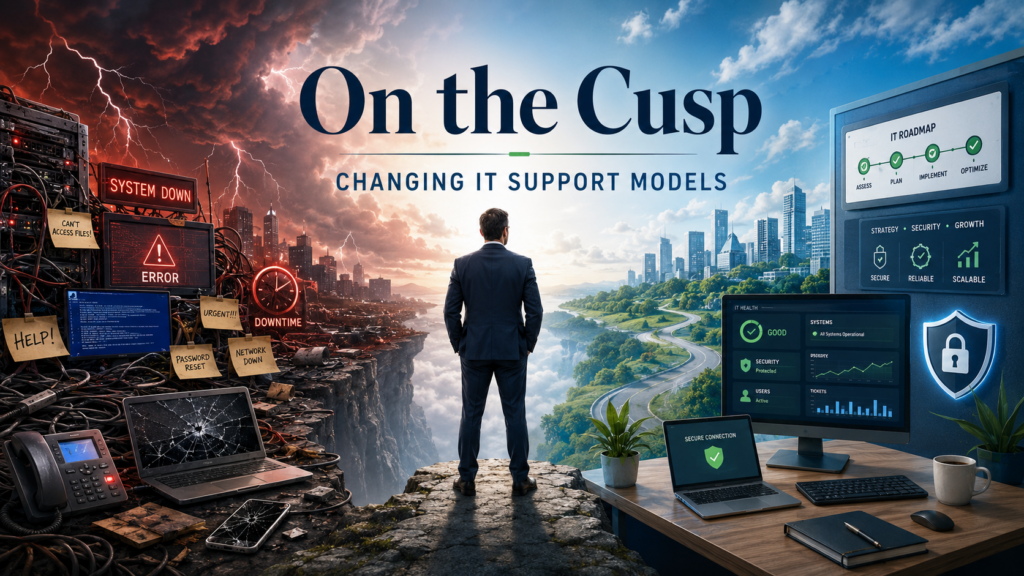
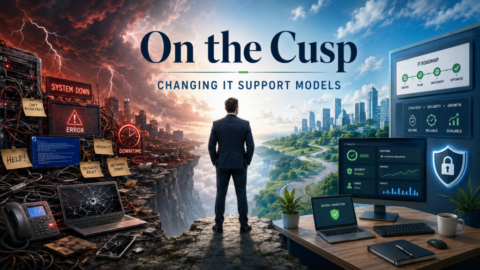
Most companies do not change IT support because everything is going well. They change when something starts to feel off.

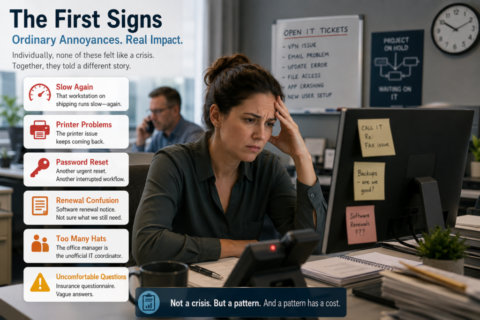
A computer slows down again. A printer problem returns. A software renewal arrives, but no one knows who still uses the licenses. A backup report says everything is fine, but no one can explain what “fine” means.

Then the cyber insurance form arrives. It asks about multifactor authentication, patching, backups, administrator access, security training, and incident response.

None of these issues looks like a crisis. Together, they reveal a larger problem: the company has someone to call when IT breaks, but no one is clearly responsible for the whole system.

That is the point where the old model begins to fail.
A Company That Had Outgrown Its Old Model

Consider North River Components, a fictional manufacturer with about 50 employees. It has one main office, a warehouse, a production floor, a few remote workers, and growing use of Microsoft 365, shared files, barcode tools, vendor portals, and customer data.

For years, North River used break/fix support. When something failed, someone called the IT company. A technician came onsite or connected remotely, fixed the problem, and sent an invoice. The model was simple and familiar. For a long time, it worked well enough.

That matters. The old model was not foolish. It fit the company when the business was smaller, the systems were simpler, and the risk was lower.  The problem was not that break/fix support suddenly became bad. The problem was that the business changed while the support model stayed the same.

The First Signs Were Easy to Miss

Bizannoyances 1024x683

The same employees kept losing time to small IT problems. The office manager became the unofficial IT coordinator. She tracked renewals, answered vendor questions, routed support calls, and tried to remember who had access to what.

The owner was still pulled into routine technology decisions that should not have needed his attention.

The IT provider usually responded when called, but that was not the deeper issue. Almost every problem still depended on someone inside the company noticing it, deciding it mattered, and asking for help.

IT was still being treated as a repair service.

North River had grown beyond that.

The Trigger Was Confidence, Not Catastrophe

The turning point was not ransomware or a server crash. It was a cyber insurance questionnaire.

The form asked direct questions. Did every user have multifactor authentication? Were systems patched? Were backups only monitored, or had they been tested? Who had administrator access? Which systems were outdated? Was there a written plan for a security event?

North River had antivirus, backups, support, and several security tools.  What it did not have was confidence in the answers, a company can own a lot of technology and still lack a clear way to manage it and trust it.

The first guess was to replace the IT company

Leadership first assumed the provider was the problem. That is a common reaction. When technology feels messy, the IT company becomes the obvious target.

Sometimes the provider really is the problem.  Most often, however, the business has not decided what kind of IT relationship it needs.

Break/fix support is built around problems after they happen. Managed support adds monitoring, patching, standard tools, and a clearer support process. IT governance goes further by adding planning, risk tracking, standards, documentation, and leadership oversight.

These are not simply different price plans. They assign responsibility in different ways.

What the Review Found

North River did not have one major failure. It had years of small issues that had built up.

Some computers were old but still in service. Software versions were not always the same. Old user accounts needed review. Backup reports existed, but restore testing was unclear. Devices had been added without enough documentation. Security tools were installed, but no one could say who reviewed serious alerts.

Most of this looked ordinary, which was exactly the point. Risk often builds through small choices: delayed replacements, one-time exceptions, old accounts, undocumented changes, and guesses that no one has checked.

North River did not have an IT disaster. It had drift.

The Real Decision Was About Risk

Once leadership saw the problem, the choice became clearer.  They were not choosing between cheap IT and expensive IT. They were choosing where the risk would sit.

Under break/fix support, the provider fixed visible problems. The business carried the risk for everything that was not being reviewed, tested, planned, or documented.

Managed support could reduce some of that risk by creating a stable base. Monitoring, patching, security tools, documentation, and routine care could become more consistent.

Governance would go further. Risks would be listed and reviewed. Standards would be clear. Replacements and projects would be planned before they became urgent. Leadership would know what needed attention, why it mattered, and what decisions were coming next.

The right choice depended on what North River expected from IT.

The Hard Part Was Changing Habits

The technical work was not the hardest part. The hard part was changing how people worked.

The owner was used to making nearly every IT decision. The office manager handled issues through calls, texts, and memory. Employees asked whoever seemed most likely to help. Older systems stayed in place because replacing them would be disruptive.

Some risks remained because no one had forced a clear discussion about them.

A more accountable model required new habits.  The company could not keep treating IT as a loose mix of devices, tickets, exceptions, and last-minute approvals. The provider could not be held responsible without enough authority to manage agreed standards. Leadership could not expect steady costs while delaying every replacement.

The business also could not expect lower risk while keeping every informal workaround.

Managed results require managed habits.

What Changed

Nothing dramatic happened on day one. There was no single fix that made IT perfect.  Instead, North River became more disciplined.

Employees used one support process. Repeat problems were tracked. Systems and accounts were documented. Access was reviewed. Backup expectations were clear, and restores were tested. Security tools had named owners. Older equipment was placed on a replacement plan. Projects were reviewed before they became urgent.

Leadership also changed how it viewed IT.

Instead of asking why an emergency cost so much, leaders could ask what should be planned over the next six to twelve months. Instead of assuming backups were fine, they could ask for proof. Instead of treating security like a checklist, they could discuss risk.

The owner still made important business decisions. He was no longer the default IT manager.

Why This Matters Now

More basic support work will become automated. That is not a bad thing. Routine tasks should be monitored, standardized, and handled efficiently.  But automation does not understand the business.

It does not know why the production floor cannot be down on a Tuesday morning. It does not know which customer portal matters most, which vendor relationship is fragile, or which risk the owner may accept for one quarter because cash is needed elsewhere.  That is where people still matter.

Good IT means knowing the business, understanding its weak points, helping leaders make tradeoffs, recording risk, and keeping the plan moving.  Sometimes that means fixing a problem. Sometimes it means using a temporary workaround. Sometimes it means telling leadership that a known risk can no longer be ignored.

That is not rigid; it is responsible.

The Lesson

North River did not need to condemn its old support model. Break/fix support had served the company when it was smaller and simpler.  The mistake would have been expecting the same model to work after the business became more dependent on technology.

Many companies get stuck here. They look for a better technician when they really need a better way to manage IT. A technician can fix a computer. Managed support can create more stability. Governance can help leadership manage technology as both a risk and a business asset.

Those are different jobs, and confusing them creates frustration for everyone.

Questions Worth Asking

A business may be reaching the same point when leaders begin asking why the same IT problems keep returning, why one employee still coordinates everything, why costs are difficult to predict, or why the answers about backups and security remain unclear.

They may also wonder why projects become urgent before they are planned, why the owner remains involved in routine IT decisions, or why the company has plenty of tools but little confidence. These are not just IT questions, they are management questions.

The Cusp

Every growing business reaches a point when its old support model deserves an honest review. Not because the old model was foolish. Not because the provider was always bad. Not because every company needs the most advanced plan.

The review becomes necessary because the business has changed.  There are more users, more systems, more cloud services, more security exposure, and more financial impact when technology fails.

At that point, the better question is no longer:

“Who do we call when something breaks?”

It becomes:

“What level of responsibility does the business now need?”

One model fixes what breaks. Another helps keep operations stable. A governance model helps leadership manage technology as a business risk.  The difference matters.

A Practical Next Step

Do not start by shopping for another provider.  Start by deciding what your business now needs: repair, ongoing support, or clear accountability for the whole environment. That discussion may show whether the real problem is the provider, the support model, or the habits inside the business.

When IT feels harder to control than it did a few years ago, the company may simply have reached the edge of its old model.

About the Author

M.

matt@thebitworks.com

CEO

Expertise in cybersecurity and helps businesses implement robust security strategies.